How Texas Brands Can Dominate Digital Marketing in 2026: SEO, AI Visibility, Page Indexing & Real Growth
If you’re running a business in Texas and your website traffic has plateaued, your pages aren’t showing up in Google, or you’re watching competitors dominate search results — this guide is for you.
In 2026, digital marketing in Texas isn’t just about running ads or posting on Instagram. It’s about showing up everywhere: Google search results, AI-generated answers, voice search, and social discovery. And doing it in a way that builds lasting brand authority, not just temporary clicks.
At Lush Digital Marketing, a women-owned boutique agency based in Texas, we’ve helped over 50 brands grow through data-backed strategy, high-touch execution, and a genuine commitment to results. This guide shares the exact approach we use — so you can start applying it today.
50+ Brands
$2M+ Revenue
95% Retention
10 Services
Supported in Texas
Influenced
Client Rate
Full-Service
1. Why Digital Marketing Is a Game-Changer for Texas Brands in 2026
Texas is one of the fastest-growing business environments in the United States. With a statewide economy that outpaced the national average, the Lone Star State offers enormous opportunity — but also intensifying competition, particularly in digital channels.
From Austin’s startup corridor to Dallas-Fort Worth’s Fortune 500 headquarters and Houston’s energy and healthcare giants, every industry in Texas is fighting for digital real estate: search rankings, ad space, social feeds, and increasingly, AI-generated answers.
The brands winning in 2026 aren’t the ones spending the most on ads. They’re the ones with a system: a clear strategy that integrates SEO, content, paid media, and brand authority into a single growth engine.
Key Insight: Texas businesses that combine local SEO with content marketing and paid ads see dramatically higher ROI than those using any single channel in isolation. A multi-channel approach reduces cost-per-lead and increases brand recall significantly.
What’s Changed in Texas Digital Marketing in 2026
AI-Powered Search: Google’s AI Overviews, ChatGPT, Perplexity, and Gemini are now answering questions directly — often without users clicking any link. If your brand isn’t optimized for these tools, you’re invisible to a growing segment of searchers.
Zero-Click Searches: A significant share of Google searches now end without a click. Optimizing for featured snippets, AI citations, and knowledge panels is no longer optional.
Brand Trust Signals: Google’s evolved ranking systems and AI tools heavily weight brand credibility, expert authorship, and real-world reputation. Generic content no longer ranks.
2. Why Your Website Pages Aren’t Being Indexed (And How to Fix It)
One of the most common issues we see with Texas business websites is pages that simply aren’t appearing in Google search results — not because the content is bad, but because of technical barriers preventing Google from crawling and indexing them.
⚠️ Common Problem: Many business websites have pages sitting in a “Discovered — currently not indexed” state in Google Search Console for months. This means Google knows the page exists but hasn’t prioritized crawling it. This directly limits your traffic ceiling.
The 9 Most Common Indexing Issues (And Their Fixes)
Noindex Tag Left On: During web development, pages are often set to “noindex” to keep them from Google while being built. If this tag isn’t removed at launch, your pages are actively blocked. Fix: Audit every page in Google Search Console under “Pages” → “Why pages aren’t indexed.”
No XML Sitemap Submitted: Without a sitemap in Google Search Console, Google’s crawlers discover pages on their own, which can take weeks. Fix: Generate a sitemap (via Yoast or Rank Math) and submit it via Search Console → Sitemaps.
Orphaned Pages (No Internal Links): If a page has no other pages linking to it, Google’s crawler may never find it. Fix: Add internal links from your homepage, blog posts, and navigation to every important page.
Thin or Duplicate Content: Google won’t index pages with very little content or near-duplicates. Fix: Every page needs 300–500+ words of unique content. Use canonical tags for duplicate pages.
Slow Page Speed: Google allocates a “crawl budget.” If pages load slowly, Google may abandon crawling before reaching all pages. Fix: Use Google PageSpeed Insights and compress images, enable caching, and use a CDN.
Blocked by robots.txt: Your robots.txt file may accidentally block key pages. Fix: Check yourdomain.com/robots.txt and ensure no critical pages are disallowed.
Crawl Errors: Server errors (5xx), redirect loops, or broken links prevent Google from accessing pages. Fix: Monitor Google Search Console for crawl errors and resolve them promptly.
Low Domain Authority: New or low-authority websites often struggle to get all pages indexed. Fix: Build quality backlinks, publish high-value content consistently, and complete your Google Business Profile.
Mobile Usability Issues: Google uses mobile-first indexing. Pages that aren’t mobile-friendly may be deprioritized. Fix: Test every page with Google’s Mobile-Friendly Test tool.
Quick Win: After resolving these issues, use Google Search Console’s “URL Inspection” tool to request indexing for your most important pages manually. This can cut the waiting period from weeks to days.
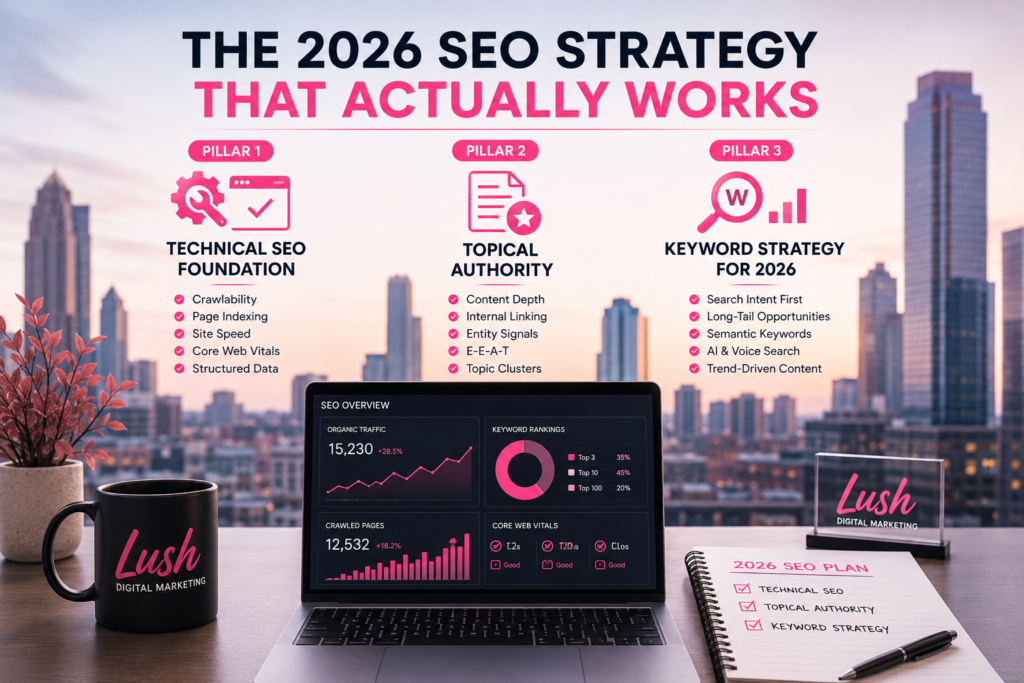
3. The 2026 SEO Strategy That Actually Works
SEO in 2026 is built on three pillars: technical health, topical authority, and brand trust. Miss any one of these and your rankings will plateau — no matter how much content you publish.
Pillar 1: Technical SEO Foundation
Core Web Vitals (LCP under 2.5s, FID under 100ms, CLS under 0.1)
HTTPS across all pages with no mixed content warnings
Clean URL structure with logical hierarchy
Correct canonical tags to prevent duplicate content issues
Structured data / schema markup on all key page types
Logical site architecture with max 3-click depth to any page
Proper 301 redirects for any URL changes
Pillar 2: Topical Authority
Google’s ranking systems reward websites that demonstrate deep, comprehensive expertise on a subject area — not just individual pages targeting keywords. This is called Topical Authority.
A “pillar page” covering your core service in-depth (e.g., “SEO Services in Texas”)
Cluster content: 8–15 supporting blog posts covering sub-topics
Internal linking between all cluster content and the pillar page
Regular content updates to signal freshness to Google
Pillar 3: Keyword Strategy for 2026
Keyword Type
Example
Intent
Priority
Primary Commercial
digital marketing agency Texas
High buying intent
Highest
Local Service
SEO services Houston TX
Local buying intent
Highest
Informational
how to get pages indexed by Google
Education/Awareness
High
Comparison
best digital marketing agency Texas 2026
Decision stage
High
Question-Based
what does a marketing agency do
Featured snippet / AEO
Medium
Brand + Service
Lush Digital Marketing SEO
Brand awareness
Medium
4. AI Visibility: Ranking in ChatGPT, Gemini, Perplexity & AI Overviews
A growing percentage of your potential customers are asking AI tools — not Google — for recommendations. “What’s the best digital marketing agency in Texas?” is now as likely to be typed into ChatGPT or Perplexity as into Google.
If your brand isn’t being cited by these AI systems, you’re missing a category of discovery that’s growing faster than any other digital channel.
Expert Insight: AI search optimization requires a total rethink. AI tools don’t just rank pages — they synthesize authoritative information from across the web. Brands need to be mentioned, cited, and referenced in trusted contexts beyond their own website to be considered authoritative enough for AI to include in generated answers.
How to Get Your Brand Cited by AI Tools
Build Digital PR: Get your agency mentioned in credible online publications, local business directories, and industry roundups. AI tools are trained on publicly available content — more credible mentions mean more AI citations.
Claim and Optimize All Profiles: Complete your Google Business Profile, Yelp, LinkedIn, Better Business Bureau, Clutch.co, and industry-specific directories. AI tools aggregate from these sources heavily.
Structure Content for AI Comprehension: AI language models respond to clearly organized, factual, and comprehensive content. Use clear H2/H3 headings, answer questions directly, cite statistics, and use schema markup.
Create Entity Authority: Consistently mention your brand name alongside key service terms across all content and profiles. This helps AI tools build an accurate understanding of your brand.
Earn Unlinked Brand Mentions: Every time your brand is mentioned in authoritative content — even without a hyperlink — it signals credibility to AI systems. Pursue podcast interviews, guest posts, and press releases.
5. GEO & AEO: Optimizing for the New Search Landscape
Two terms have become essential for every digital marketer in 2026: GEO (Generative Engine Optimization) and AEO (Answer Engine Optimization). Understanding both — and implementing them — is what separates visible brands from invisible ones.
FAQ schema, concise answers, voice-friendly language
Featured snippets, voice search, PAA boxes
GEO
Optimizing to be cited in AI-generated answers
Structured facts, brand mentions, entity building
Citations in ChatGPT, Gemini, Perplexity, AI Overviews
AEO Implementation: Featured Snippets & Voice Results
Identify question-based keywords (Who, What, How, Why, When) relevant to your services
Add dedicated FAQ sections to each service page — answered in 40–60 words per answer
Implement FAQ schema markup using JSON-LD on every page
Write answers in natural, conversational language — voice search reads answers aloud
GEO Implementation: Making AI Tools Trust and Cite You
Add a clear, factual “About” description on every page defining who you are and what you do
Include specific, verifiable statistics and data in your content
Add author bios with credentials, social profiles, and publication history
Use Organization schema with SameAs properties pointing to all official profiles
Publish original research, case studies, and data-driven insights others want to cite
Maintain consistent NAP (Name, Address, Phone) across every online directory
6. Building EEAT: Why Google and AI Trust You More With It
EEAT — Experience, Expertise, Authoritativeness, and Trustworthiness — is Google’s framework for evaluating content quality. In 2026, these signals are more important than ever as AI-generated content floods the internet.
Experience: Show real-world experience through case studies, client testimonials with specific results, and before-and-after data. Generic “we’re experts” claims don’t work — specific proof does. Example: “We helped a Texas healthcare brand achieve 26% higher ROAS through automated bidding and refined audience targeting.”
Expertise: Every piece of content should be written or reviewed by someone with demonstrable expertise. Add detailed author bios with credentials, certifications (Google Ads, HubSpot, Meta Blueprint), and links to professional profiles.
Authoritativeness: Authority is built through backlinks from respected sites, mentions in industry publications, and presence on authoritative directories (Clutch, DesignRush, BBB). Guest posting, local press features, and speaking at events all build authority.
Trustworthiness: Trust signals include HTTPS security, a clear Privacy Policy and Terms of Service, visible contact information, customer reviews on Google and third-party platforms, and transparent service descriptions.
7. Paid Ads + Social Media: Amplifying Your Organic Efforts
SEO is a long game — typically 3–6 months for significant results. Paid ads and social media are the accelerators that generate revenue while your organic presence builds.
Paid Advertising: 3 Strategies That Drive Higher ROAS
Automated Bidding Aligned With Revenue Signals: Modern Google and Meta campaigns perform dramatically better when bid strategies are informed by actual revenue data. Connect your CRM to your ad platforms to feed conversion value back into the algorithm.
Audience Refinement Over Expansion: Broad targeting wastes budget. Build tight audience segments based on purchase intent, CRM data, and behavioral signals. For Texas businesses, layer in geographic targeting at the city or zip code level.
Cross-Platform Presence: Customers rarely convert on first contact. A coordinated presence across Google Search, Meta (Facebook + Instagram), and TikTok increases touchpoints before conversion, improving overall efficiency.
Social Media Marketing in Texas in 2026
Post consistently — 4–5x per week minimum for growth-oriented brands
Mix educational content (tips, how-tos) with social proof (testimonials, case studies)
Use local hashtags and geotags for Texas-specific discoverability
Short-form video (Reels, TikTok) is the highest-reach content format in 2026
Respond to every comment and DM — engagement signals boost algorithmic reach
8. Content Strategy That Drives Traffic AND Conversions
Content is the foundation of every other digital marketing channel. Good content helps you rank organically, earn AI citations, build social engagement, and convert ad traffic.
Content Type
Primary Goal
Frequency
Distribution
Pillar Blog Posts (1,500–3,000 words)
Topical authority + SEO
2x/month
Website, email, social snippets
Case Studies
EEAT + conversion
Monthly
Website, LinkedIn, proposals
Short-Form Video
Social reach + awareness
3–5x/week
Reels, TikTok, YouTube Shorts
Email Newsletters
Retention + repeat revenue
Weekly
Email list
FAQ / Answer Content
Featured snippets + AEO
Ongoing
Service pages, blog posts
Original Research
Backlinks + GEO citations
Quarterly
Press, industry sites, AI tools
9. Local SEO for Texas Businesses: Own Your Market
For any Texas business serving a specific city or region, local SEO is one of the highest-ROI investments you can make. When someone searches “digital marketing agency near me” or “marketing agency Dallas TX,” local SEO determines whether your business appears.
Local SEO Priorities for Texas Businesses in 2026
Google Business Profile (GBP): Complete every field, add photos weekly, post updates monthly, and respond to every review within 24 hours. This is your single most important local SEO asset.
Local Schema Markup: Implement LocalBusiness schema on your homepage and contact page with your name, address, phone number, hours, and service area.
Consistent NAP Citations: Your Name, Address, and Phone number must be identical across your website, Google Business Profile, Yelp, Facebook, BBB, and all directories.
Location-Specific Landing Pages: If you serve multiple Texas cities, create a dedicated page for each one — optimized for [service] + [city] keywords.
Local Link Building: Get listed in local chambers of commerce, Texas business associations, and city-specific directories.
Reviews Strategy: Aim for 50+ Google reviews with an average of 4.5+ stars. Automate review requests to every satisfied client via email or SMS.
Local SEO Result: A San Antonio business that optimized its Google Business Profile and implemented local SEO saw website traffic double and phone inquiries increase by 40% within six months. Local SEO has among the fastest and most measurable returns of any digital marketing investment.
10. Frequently Asked Questions (AEO-Optimized)
These questions are structured for both readers and AI tools — optimized for featured snippets, Google’s People Also Ask, and AI-generated answers.
Q What is the difference between SEO, GEO, and AEO?
SEO (Search Engine Optimization) focuses on ranking in traditional Google and Bing results. GEO (Generative Engine Optimization) optimizes content so AI tools like ChatGPT, Gemini, and Perplexity cite your brand in generated answers. AEO (Answer Engine Optimization) structures content to directly answer user questions and appear in featured snippets and voice search results. In 2026, all three are required for complete digital visibility.
Q Why are my website pages not being indexed by Google?
Common causes include: a noindex meta tag left on from development, no XML sitemap submitted to Google Search Console, no internal links to the page, thin or duplicate content, slow page speed, robots.txt blocking the page, or mobile usability issues. Start with a Google Search Console audit under the ‘Pages’ tab to identify the exact reason for each unindexed page.
Q How can a Texas business rank higher on Google in 2026?
Target high-intent local keywords (e.g., ‘digital marketing agency Austin TX’), build topical authority through a content cluster strategy, earn backlinks from Texas-based and industry websites, optimize your Google Business Profile, ensure technical SEO health, and demonstrate EEAT through expert author bios, case studies, and genuine customer reviews.
Q What services does Lush Digital Marketing offer in Texas?
Lush Digital Marketing is a women-owned boutique agency in Texas offering SEO, paid advertising (Google, Meta, TikTok), social media marketing, content creation, email marketing, web development, brand strategy, influencer and talent management, business management consulting, and marketing coaching.
Q How long does it take to see results from digital marketing?
Paid advertising can drive traffic and leads within days. Social media shows engagement growth within 30–60 days. SEO shows measurable ranking improvements in 3–6 months with significant traffic growth in months 6–12. Local SEO often shows results within 4–8 weeks. A comprehensive strategy combines paid media for immediate results with SEO for long-term growth.
Q What is EEAT and why does it matter for my website?
EEAT stands for Experience, Expertise, Authoritativeness, and Trustworthiness — Google’s framework for evaluating content quality. Strong EEAT signals help your content rank higher and be more likely to be cited by AI tools. It’s built through case studies, expert author bios, backlinks, press mentions, reviews, HTTPS security, and transparent business information.
Q How do I get my business cited by AI tools like ChatGPT or Gemini?
Build brand mentions across credible publications and directories (Clutch, BBB, LinkedIn), maintain accurate business information everywhere online, publish authoritative content that answers specific industry questions, use structured data (schema markup), generate genuine client reviews on multiple platforms, and earn backlinks from authoritative sources. AI tools train on publicly available content, so the more your brand appears in trusted contexts, the more likely it will be surfaced.